
For organisations running Microsoft 365 today
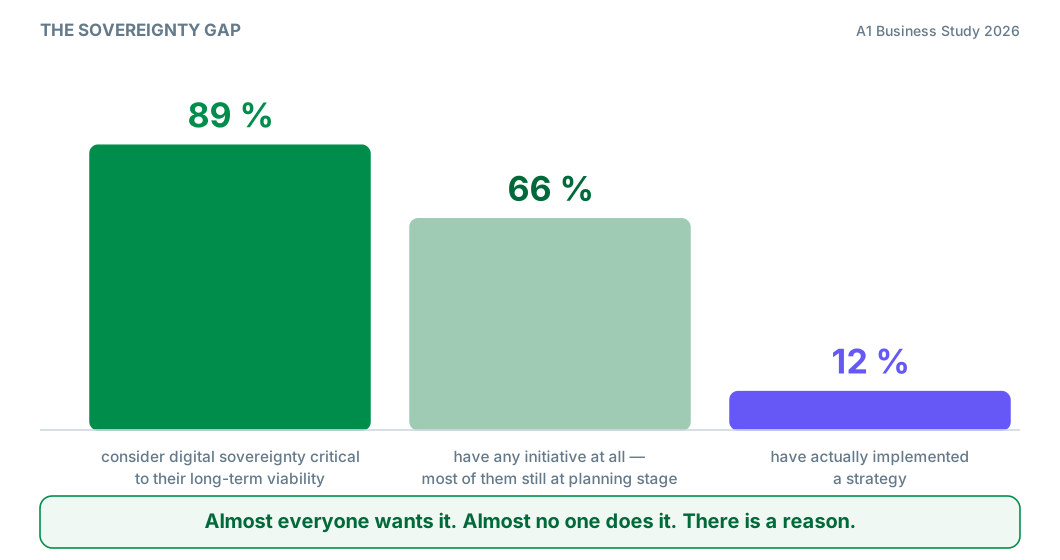
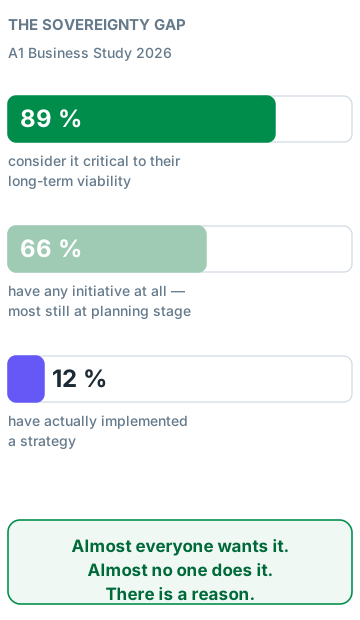
89 % call digital sovereignty critical.
But only 12% have done it.
Not out of complacency. Because the route there has always been a migration project and a migration project founders on people, on money, and on precisely the dependency it set out to dissolve.
This page is about why that is not the only route.
77 % dependent on digital services
53 % name vendor lock-in as a hurdle
1 — THE SITUATION
Almost everyone wants it.
Almost no one does it.
The A1 Business Study 2026 surveyed 300 decision-makers in organisations with 50 or more staff. The result is unusually clear and unusually contradictory.
The finding
The dependency is understood
77 % describe themselves as strongly or somewhat dependent on digital technology. 43 % expect that dependency to grow further over the next twelve months.
The intent
And it is meant seriously!
Seven in ten consider digital sovereignty important, 40 % very important. 89 % see it as critical to their own organisation's long-term viability.
The reality
12%
That is how many have actually implemented a strategy. Another 54 % are planning or in progress. The remainder have not started at all.
It does not fail on willingness, but on the route and until now that route always ran through a migration project.
2 - WHY IT DOES NOT HAPPEN
Three hurdles.
One shared cause.
The same study asks for the reasons. The three most frequently named hurdles look at first like three separate problems. They are not.
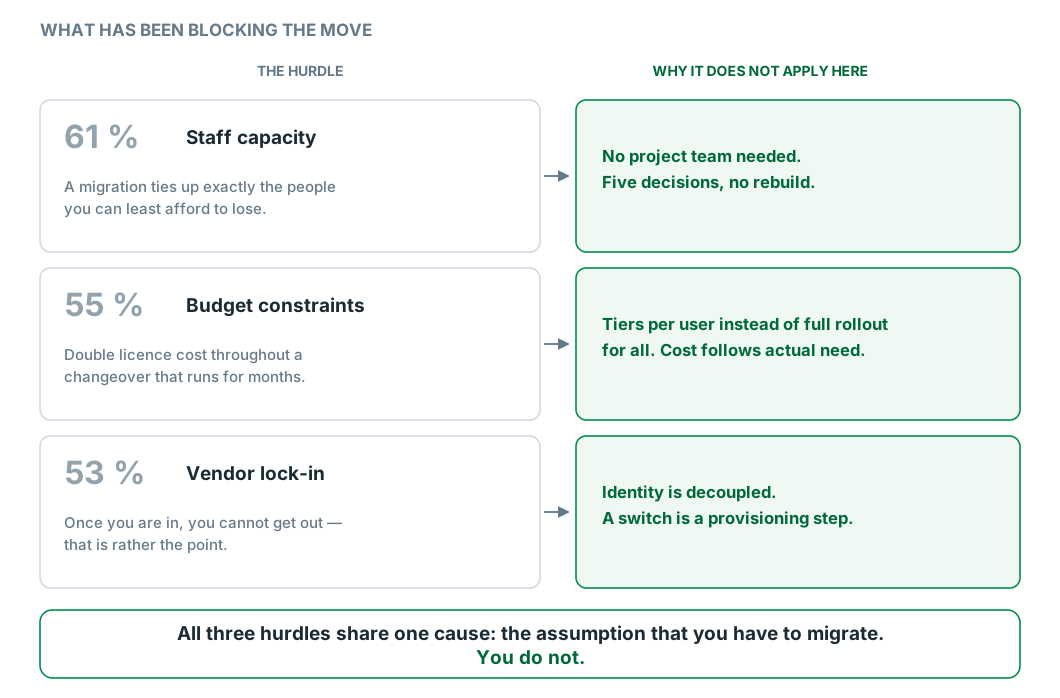
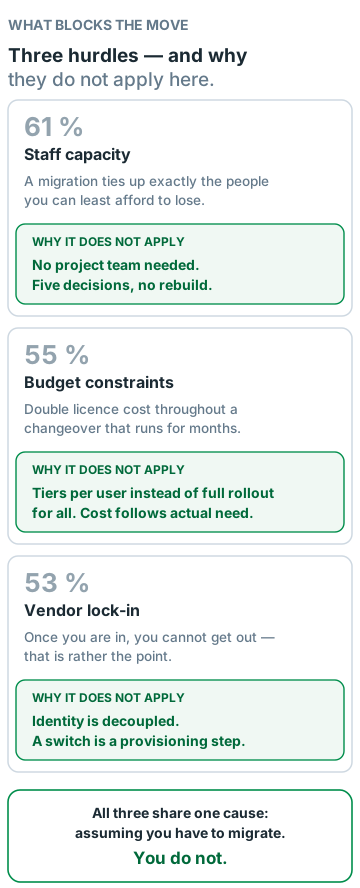
Staff, money, lock-in — all three follow from the same assumption: that sovereignty means replacing something that exists. A replacement needs a project team, it needs budget for parallel operation during the changeover, and it founders on exactly the entanglements it was meant to remove.
Build the sovereign environment alongside instead, and keep filling it with your identities, files and conversations as they arise — and none of these three hurdles applies.
3 - WHY THE TOPIC IS NOT GOING AWAY
What you do not control,
is controlled by someone else.
Dependency stays abstract as long as nothing happens. These four events are documented and verifiable.
The price
Set without you
On 1 July 2026 Microsoft raises list prices for its commercial Microsoft 365 plans — by roughly 9 to 25 per cent depending on the plan. It was announced in December 2025. It was not negotiated.
The access
Under oath: no guarantee
In June 2025 a Microsoft representative was asked before a French Senate inquiry whether he could guarantee that French citizens' data would not be handed over under a lawful US order. His answer: „Non, je ne peux pas le garantir.“
No, I cannot guarantee that. The shut-off
Microsoft pulled the plug
In February 2025 the United States imposed sanctions on the chief prosecutor of the International Criminal Court. His Microsoft account was subsequently blocked; he moved to a Swiss provider. A year later Microsoft had to correct a statement made to the UK House of Commons: its representative had said there that the Court, not Microsoft, had decided the shut-off. Microsoft asked Parliament to correct the record. The Court is now moving to a European open-source solution.
The legal position
The CLOUD Act knows no borders
US companies must hand over data on official order — regardless of where that data physically sits. A data centre in Europe changes nothing about this as long as the operator is subject to US law.
They describe what it means when a central capability of your organisation belongs to somebody else.
4 - THE APPROACH
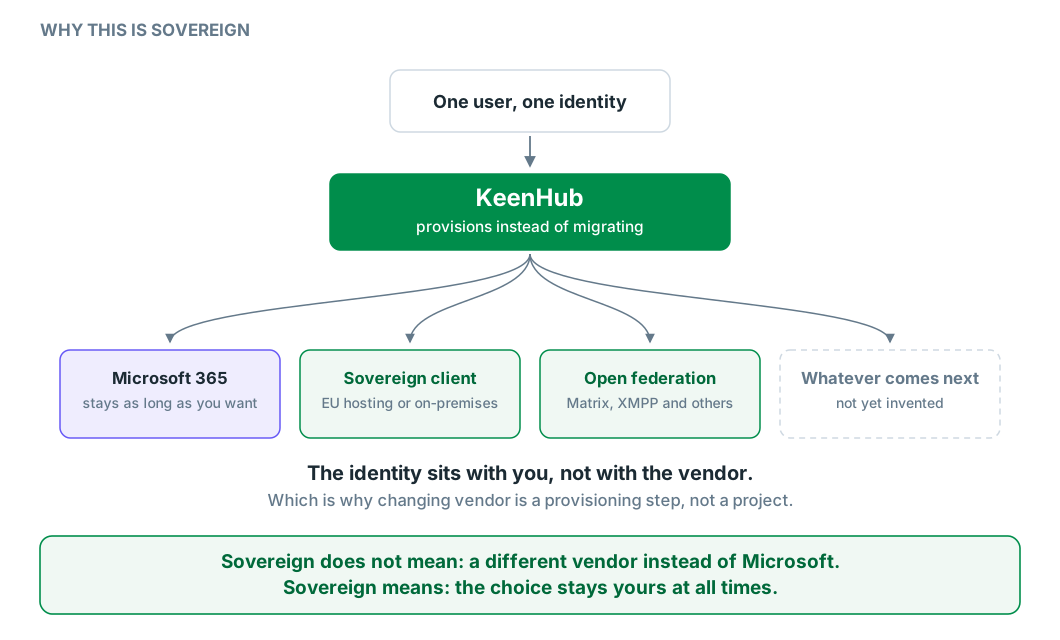
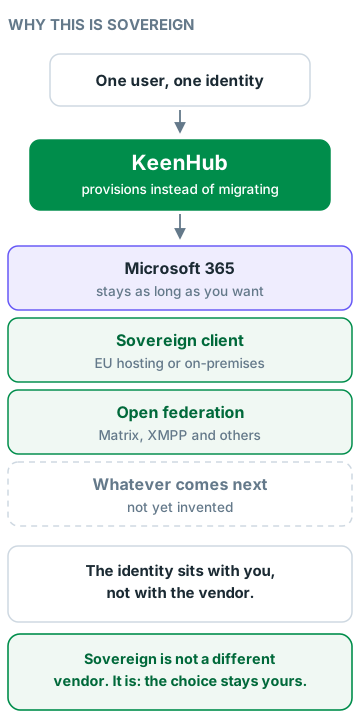
Sovereign does not mean:
a different vendor instead of Microsoft.
Replace Microsoft with a single European vendor and you have moved the dependency, not dissolved it. Sovereignty exists where the decision stays reversible.
Multi-Vendor
The identity sits with you
A user is created once, centrally, and provisioned onto every target platform. The identity therefore no longer lives inside the vendor's system. Changing vendor becomes a provisioning step — not a migration project that runs across quarters.
Multi-protocol
The conversations belong to you
The client speaks several protocols and connects further systems through open federation instead of building a new silo. Every conversation runs at the security level it needs — open matters over open paths, confidential matters over shielded, end-to-end encrypted channels.
The difference is not where the servers stand. The difference is whether you can still decide tomorrow where they should stand.
5 - MAKING THE MOVE
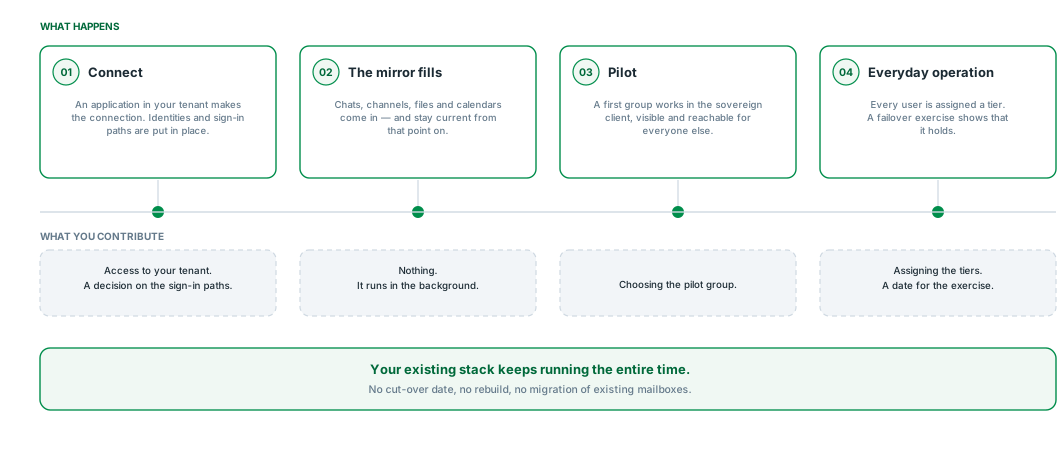
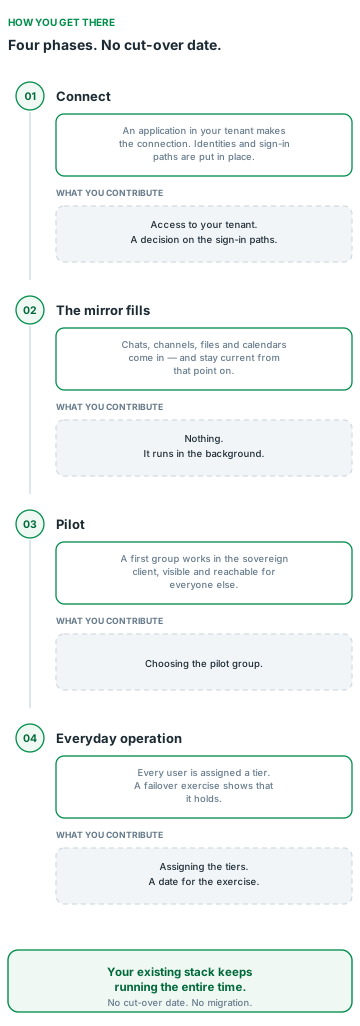
No cut-over date. No rebuild.
No migration.
The sovereign environment grows alongside your existing estate, not in its place. You move nothing — you put something next to it and decide later who uses how much of it.
What you gain — from day one
- A shielded channel for confidential conversations, which in many organisations personal messengers currently handle
- An identity layer that turns changing vendor into a provisioning step — which is also your exit strategy
- A second, independent communication path that survives an outage at your main vendor
- A demonstrable state of implementation instead of a statement of intent
What you do not give up
- Microsoft 365 stays as long as you want it and runs unchanged
- No migration of mailboxes, teams or file stores
- No second interface everyone would have to learn
- No cut-over date at which something could go wrong
You do not have to choose between Microsoft and sovereignty. You only have to keep the choice open.
6 - THE TIMING
The legal position
is currently working for you.
The EU Data Act has applied since 12 September 2025. It is aimed explicitly at switching barriers in cloud services.
From 12 January 2027
Switching charges disappear entirely
Until then, providers may only charge the costs directly incurred by a switch. After that, nothing at all. Anyone who has prepared the switch technically can then make it without financial friction.
What that means in practice
Preparation beats haste
The legislator is clearing away the commercial hurdle. It is not clearing away the technical one — entangled identities and data with no way out. That is precisely what can be dissolved beforehand, without your having to leave anything today.
7 - FREQUENTLY ASKED QUESTIONS
Do we have to give up Microsoft 365?
No, and that is the heart of the approach. Microsoft 365 remains your primary system and runs unchanged. The sovereign environment sits alongside it. You decide per user how much of it anyone actually uses — and you can change that decision at any time, in either direction.
Is this not simply a different lock-in?
A fair question, and the test for it is simple: how do you get out again? Because identities are held centrally and provisioned onto target platforms, moving away from us is the same operation as moving to us. Communication runs over open protocols and federation, not a proprietary format. If that is not true, the promise is worthless — so ask about it specifically in the conversation. The mechanics behind it are set out on the KeenHub page.
We have almost no people for projects. How much effort is this?
On your side it is five decisions: access to your tenant for the connection, deciding the sign-in paths, choosing a pilot group, assigning tiers per user, and a date for the first drill. No project team, no migration planning, no data transfer.
What does this cost on top of our existing licences?
Charging follows user tiers. Someone using the sovereign environment daily costs more than someone for whom only the context is mirrored, who in turn costs more than a pure emergency access. Because you assign the tiers per user, cost scales with actual need rather than headcount. Concrete figures depend on your user profile.
Where does the data sit?
You choose the operating model: in your own data centre, in an EU-sovereign cloud, hybrid with management in the cloud and data on your premises, or fully air-gapped with no outward connection. The functional scope is the same in all four models.
Is a European data centre from Microsoft not enough?
Storage location is not the decisive criterion — applicable law is. US providers are subject to the CLOUD Act even when their servers stand in the EU. That is not an interpretation but the stated position of the US Department of Justice — and it is exactly why a Microsoft representative was unable to give a guarantee before the French Senate.
Our people have used Teams for years. Do they have to relearn?
Only those who want to. The large majority carry on exactly as before; for them the mirroring runs invisibly in the background. Only the group that deliberately works in the sovereign client sees a different interface — and they remain visible, callable and invitable for every Teams user.
What about our partners and customers outside the organisation?
Nothing changes for them. Users of the sovereign environment remain reachable through the Teams connection. Beyond that, further messaging systems can be connected through open federation instead of running a separate tool for every counterpart.
How long does the rollout take?
That depends on your data volume and cannot honestly be answered before a stocktake. More important for planning anyway: none of the phases has a cut-over date. Operations continue throughout, including while the mirror is still building up.
We already have a sovereignty strategy. Where does this fit?
Usually at the question such strategies leave open longest: communication. Line-of-business applications can be moved step by step because they are clearly bounded. Communication is everywhere at once — identity, chat, mail, files and telephony all hang together. Which is exactly why it sits at the end of so many roadmaps. Running in parallel reverses that order.